Best Time to Sell a Used Tesla Model Y: Timing Your Exit for Maximum Value
Selling a used Tesla Model Y at the right time maximizes your return and minimizes days on market. Battery health, market liquidity, and seasonal demand cycles determine when to list.
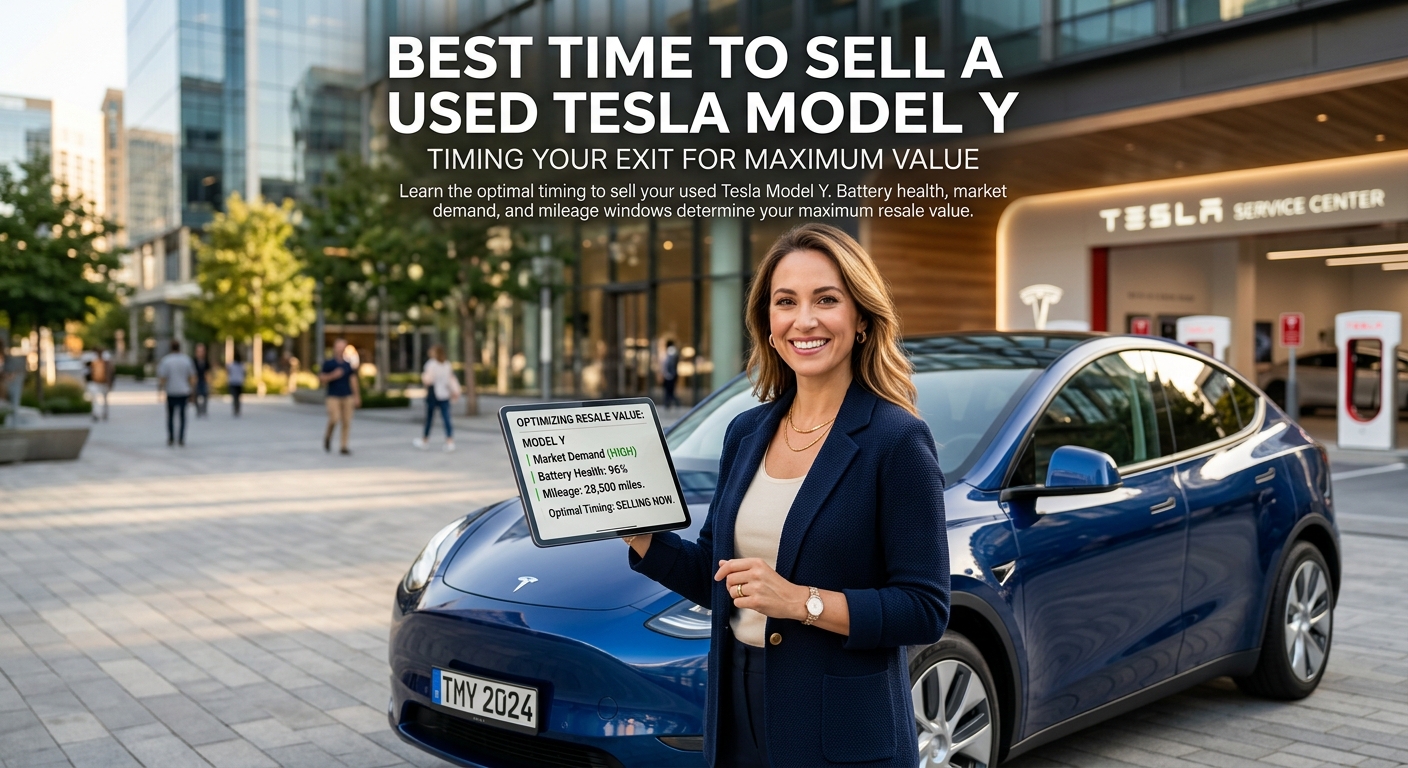
Timing matters more than mileage
The best time to sell a used Tesla Model Y isn't tied to a calendar date. It's when three factors align: your battery health is still strong, dealer liquidity is high, and seasonal demand favors SUVs. Most sellers wait too long, thinking another year of ownership won't hurt resale. It does. Battery degradation accelerates pricing uncertainty, and dealer appetite for aging inventory drops faster than the vehicle's actual utility declines.
First-time EV sellers often assume the used Tesla market mirrors the gas-powered SUV market. It doesn't. Traditional trade-in windows spring for tax refunds, fall for year-end clearance don't carry the same weight when battery transparency determines whether a dealer will stock your vehicle at all. The Model Y resale window is tightest between 20,000 and 60,000 miles, when battery data is abundant and depreciation curves flatten. Beyond that range, you're competing with newer inventory that carries less risk for the next buyer.
Battery health sets the clock
Every additional year you hold a Model Y adds uncertainty to its battery condition, and uncertainty compresses offers. Lithium-ion cells degrade predictably in the first three years, then variability increases based on charging habits, climate exposure, and usage patterns. Dealers price that variability as risk. If you're approaching 80,000 miles or five years of ownership, the window for strong liquidity is closing.
Battery health isn't just about range. It's about data availability. Vehicles with recent battery reports from third-party providers like Recurrent Auto or Tesla's own service records move faster and command tighter bid-ask spreads. If your Model Y hasn't had a battery health check in the past year, get one before listing. Transparency doesn't just improve your price it determines whether you get competitive bids at all.
The market penalizes ambiguity more than it rewards low mileage. A 60,000-mile Model Y with documented 92% battery capacity sells faster than a 30,000-mile unit with no recent data. Dealers can price the former; they have to discount the latter to cover unknowns.
Seasonal demand favors Q1 and early fall
Model Y inventory turns fastest in January through March and again in September through early November. The first quarter captures tax refund buyers and corporate fleet refreshes. Early fall aligns with model-year transitions, when dealers clear space for incoming inventory and buyers expect better selection. Both windows benefit from higher participation more buyers, more competitive bids, shorter time to sale.
Summer is the weakest season for used EV liquidity. Dealer lots fill with trade-ins from spring sales, and buyer attention shifts to vacation spending. Listing a Model Y in June or July extends your days on market and invites lowball offers from dealers sitting on excess inventory. If you're planning a summer sale, list in late May to capture pre-vacation demand.
Winter presents a regional split. Northern markets see slower turnover due to range anxiety around cold-weather performance, even though the Model Y's heat pump mitigates most concerns. Southern and Western markets maintain steady demand year-round. If you're in a cold-weather state, aim for a spring listing. If you're in California, Texas, or Florida, seasonality matters less than battery condition and competitive pricing.
Market liquidity peaks before major updates
Tesla's pricing volatility and frequent updates create resale windows that open and close faster than traditional automaker cycles. The Model Y received a mid-cycle refresh in late 2024, and rumors of a next-generation platform have circulated since early 2025. Each announcement compresses the resale window for older units.
The months immediately before a confirmed refresh are the worst time to sell. Buyers delay purchases, dealers reduce acquisition budgets, and your vehicle competes with the promise of something newer. The months immediately after a refresh are better early adopters have moved on, and the previous generation becomes the value play. But the sweet spot is the year following a refresh, when the market has absorbed the changes and pricing stabilizes.
If you're holding a 2021 or 2022 Model Y, you're in the stable zone. These vehicles predate the 2024 updates but aren't old enough to trigger battery anxiety. If you're holding a 2020 or earlier unit, the window is narrower. Dealers are already discounting first-generation inventory to move it before the next wave of trade-ins arrives.
Mileage thresholds create pricing cliffs
Model Y resale value doesn't decline linearly. It drops in steps at specific mileage markers: 36,000 miles (end of factory warranty coverage for many components), 60,000 miles (psychological threshold for "high mileage" in the EV market), and 100,000 miles (battery warranty expiration for some early units). Selling just before these thresholds preserves value. Selling just after them invites steeper discounts.
The 36,000-mile mark matters less for Tesla than for other brands because the battery and drive unit carry an eight-year, 120,000-mile warranty. But dealers still use it as a pricing signal, especially when comparing your Model Y to lower-mileage alternatives on their lot. If you're approaching 35,000 miles, list immediately. If you've crossed 37,000, the damage is done wait until you're closer to 50,000 to avoid the awkward middle ground.
The 60,000-mile threshold is harder. Crossing it moves your vehicle into a different buyer segment: cost-conscious households looking for value over newness. That segment is price-sensitive and slower to transact. If you're at 58,000 miles, sell now. If you're at 62,000, hold until 70,000 to reach the next stable pricing band.
Dealer appetite varies by region
Model Y liquidity isn't uniform across the U.S. California, Washington, and Colorado have deep dealer networks with EV-specific expertise. Texas and Florida have growing participation but less infrastructure for battery assessments. The Midwest and Southeast still treat EVs as specialty inventory, which means fewer competitive bids and longer holding periods.
If you're in a high-liquidity market, timing flexibility increases. You can afford to wait for the right seasonal window or hold out for a better offer. If you're in a fragmented market, the best time to sell is whenever you find a dealer willing to make a firm offer. Liquidity risk outweighs seasonal optimization when participation is thin.
Plug operates nationally, but even we see regional variance in turn times. A Model Y listed in Los Angeles moves in days. The same vehicle in Indianapolis might sit for weeks while we source the right buyer. Geography doesn't change your vehicle's value, but it changes how long you'll wait to realize it.
When not to sell
Three scenarios argue for holding your Model Y longer. First, if you're within 12 months of paying off your loan, waiting eliminates the trade-in payoff complexity and improves your net proceeds. Second, if Tesla has announced but not yet released a refresh, holding through the announcement cycle lets you sell into the stabilized post-launch market. Third, if your battery health is below 85% and you haven't documented it, investing in a third-party assessment before listing will recover more value than selling blind.
The worst time to sell is when you're reacting to a headline about EV depreciation or market slowdowns. Those stories describe aggregate trends, not your specific vehicle. A well-maintained Model Y with transparent battery data and competitive pricing finds buyers regardless of sentiment. Panic selling into a soft market guarantees you'll leave money on the table.
Get liquidity, not guesses
The used Tesla market rewards preparation more than patience. If your Model Y has strong battery health, reasonable mileage, and you're listing in a high-liquidity season, you'll see competitive offers within days. If any of those factors are weak, waiting won't fix them it'll just compress your options further.
Plug specializes in exactly this scenario: matching first-time EV sellers with dealers who understand battery data and price accordingly. We don't guess at your vehicle's value; we source real bids from participants who know how to evaluate electric inventory. If you're trying to time your exit, get in touch with the Plug team. We'll tell you what your Model Y is worth today and whether waiting improves your position or just delays the inevitable.
Related Articles
 ev-resale-guides
Tesla Model Y Resale Value in 2026: What Sellers Can Expect
Model Y resale values stabilized in 2026 after two years of steep depreciation, with Long Range variants holding 55-60% of MSRP at three years and Performance trims retaining slightly more.
 ev-resale-guides
How Much Does Tesla Warranty Coverage Add to Your Model Y's Resale Value?
Remaining Tesla warranty coverage matters to buyers, but it doesn't translate to dollar-for-dollar resale premiums. Battery warranty length drives more pricing confidence than powertrain coverage alone.
 ev-resale-guides
Tesla Model Y Pricing After New Incentives: What Sellers Need to Know
Federal tax credits and state rebates reshape Model Y transaction prices, but used sellers compete with new inventory carrying up to $7,500 in buyer incentives. Understanding the spread determines realistic pricing.